
Moving Deck Ovens, Dough Mixers and Bakery Equipment: A Shipping Guide
September 21, 2026
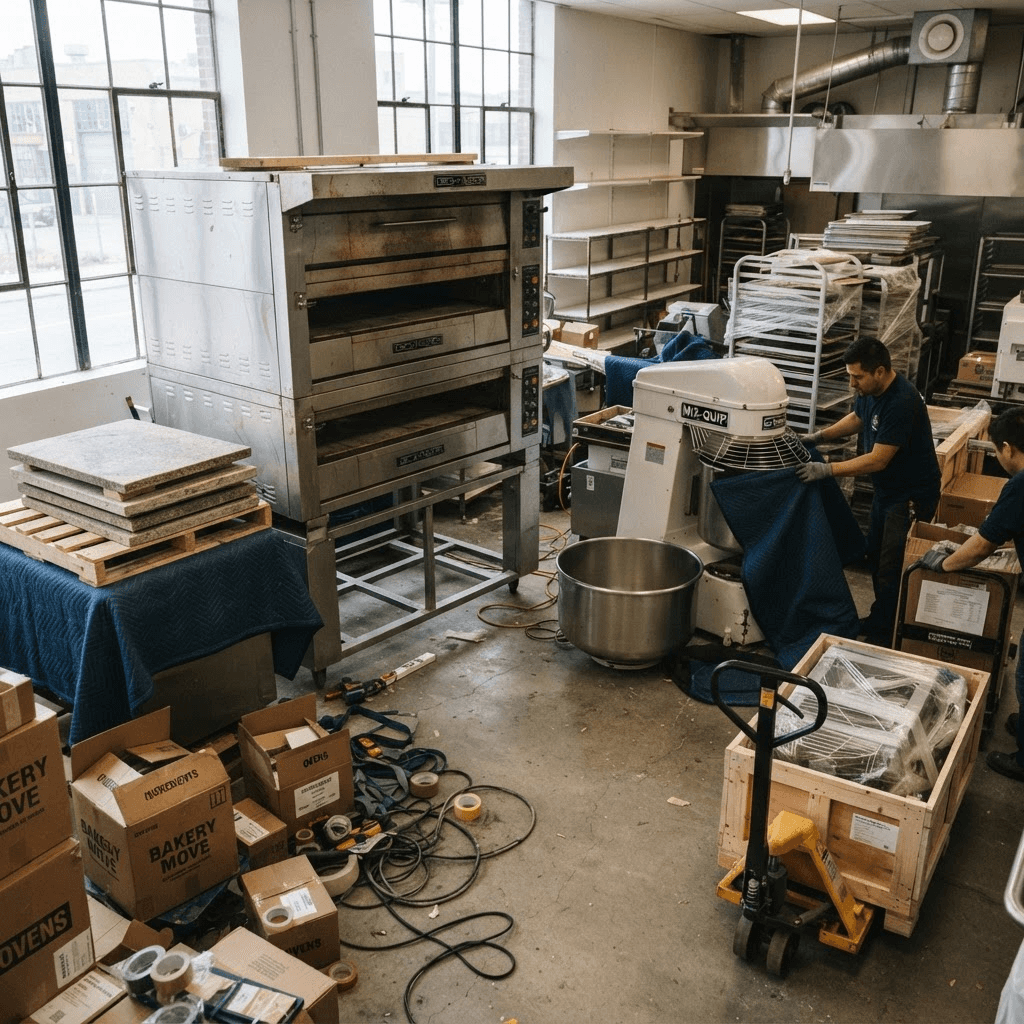
Bakery equipment is its own freight problem. Unlike a stainless prep table or a reach-in, most bakery gear concentrates enormous weight on a small footprint — a stacked deck oven can put over a thousand pounds per deck onto four narrow legs, and the decks themselves are firebrick or stone that cracks the moment they flex. Add cast-iron mixer gearboxes that must never be tipped with oil in them, and you have equipment that punishes any shortcut in packing or handling. This guide walks through how each major category should actually move.
Why bakery equipment breaks the usual rules
Three things make bakery equipment high-risk in transit. First, extreme point loads: the weight rides on small feet or casters that punch through a trailer floor or crack a warehouse slab if it is not spread. Second, brittle decks: the firebrick and stone hearths that give bakery ovens their bake are rigid and unforgiving, and they shatter under the flex and vibration of ordinary freight. Third, cast-iron gearboxes: dough mixers carry heavy geared drives with oil reservoirs that migrate the instant a unit is laid over. Every step below exists to manage one of those three risks — and all of it depends on proper crating. Read our guide to crating and rigging commercial kitchen equipment for the fundamentals this builds on.
Deck ovens: ship deck by deck
Stacked deck ovens almost never travel assembled. Each deck typically weighs 800 to 1,200 pounds, so the stack is separated and shipped one deck at a time, with the frame or legs removed and packed flat. The stone hearths come out and are crated flat and separately, sandwiched with rigid support so they cannot flex — a stone deck that rides loose or on edge will crack. Gas manifolds, thermocouples, and steam tubes are removed or protected, and every opening is padded. Reassembly and re-leveling happen on site, which is why documenting the stack order before disassembly matters.
Dough mixers: drain, disassemble, and never strap the bowl guard
Spiral and planetary mixers span a huge range, from 20-quart bench units to 140-quart floor models, and each ships differently. On anything but the smallest bench mixer, the bowl and the agitator or spiral come off and are crated separately so their weight is not hanging on the mixer head in transit. Critically, the gearbox oil is drained before the unit is ever tilted or laid down — tipping a full gearbox pushes oil into places it does not belong and can starve the drive on startup. And never run straps over the bowl guard or safety cage: it is sheet metal, not structure, and it will fold. Strap to the base and frame only.
Proofers, retarders, and dough sheeters
Proofers and retarders are refrigerated, so they follow refrigeration rules: keep them upright the entire move, and give the compressor oil time to settle before startup — plan to let the unit stand powered-off for at least as long as it spent in transit. Dough sheeters travel with their rollers locked and the belt tension released so the rollers cannot shift and dent; the fold-down tables are secured or removed. Glass doors and control panels get the same padded, cratered protection as any fragile face.
Pizza conveyor ovens: break them down modular
Conveyor ovens are designed to come apart, and they should. The oven splits into its modular sections, and the conveyor belt and drive chain are removed and packed separately so the belt does not kink and the chain does not gouge the chamber. Blowers, fingers, and control ends are labeled during teardown so reassembly is straightforward. Shipped as modules, a conveyor oven is far easier — and cheaper — to move than one crated whole.
Site access is half the job
Bakery equipment is heavy on a narrow base, which makes the path in and out as important as the truck. Floor protection and steel road plating matter: without them, a loaded oven on small casters will crack tile, gouge finished floors, or sink into soft ground at the dock. Freight elevators are the other trap — a single deck can exceed a passenger-rated elevator, so the freight elevator weight limit has to be confirmed before the truck arrives, not discovered on delivery day. These access realities are exactly why a walkthrough beats a guess, and why costs vary so much from site to site; our guide to what it costs to ship restaurant equipment breaks down the factors.
A short pre-shipment checklist
Before pickup day, confirm the essentials: photograph and label the deck stack order and any teardown; drain gearbox oil on mixers and remove bowls and agitators; pull and flat-crate stone hearths with rigid support; lock sheeter rollers and release belt tension; keep proofers and retarders upright and plan compressor settle time; remove conveyor belts and drive chains; and verify doorway clearances, floor protection, and freight elevator weight limits on both ends. A tight checklist up front is what keeps a bakery move on schedule.
Moving a bakery or a single deck oven? Send us the equipment list, weights, and site details and we will crate, rig, and ship it right. Call (866) 216-7742 or request a quote online and a coordinator will reply within one business day.
Related service
Cooking Line & Oven TransportRelated
Need to move restaurant equipment?
Nationwide & international. Get a same-day quote.